Boezio De Consolatione Philosophiae Pdf Printer
Results 1 – 23 of 23 De consolatione philosophiae. By Boezio,Severino. And a great selection of related books, art and collectibles available now at. Download Citation on ResearchGate Quello non conosciuto da molti libro di Boezio: De Consolatione Philosophiae and Its Role in the Making of the Vita Nova.
Contents.Description A golden volume not unworthy of the leisure of or —The Consolation of Philosophy was written in AD 523 during a one-year imprisonment Boethius served while awaiting trial – and eventual execution – for the alleged crime of under the King. Boethius was at the very heights of power in, holding the prestigious office of, and was brought down by treachery. This experience inspired the text, which reflects on how evil can exist in a world governed by God (the problem of ), and how happiness is still attainable amidst fickle fortune, while also considering the nature of happiness and God. It has been described as 'by far the most interesting example of the world has ever seen.' Boethius writes the book as a conversation between himself and Lady Philosophy. Lady Philosophy consoles Boethius by discussing the transitory nature of fame and wealth ('no man can ever truly be secure until he has been forsaken by Fortune'), and the ultimate superiority of things of the mind, which she calls the 'one true good'.
Lecher antenna manual. Every organ, tissue or cell has its own specific vibrational frequency. This EM-radiation is what is being measured with the Lecher antenna. Therefore, the exact level of health or pathology of an internal organ or tissue can be measured with the Lecher Antenna. Ne xt Lecher antenna basic course (6 days) starts in the fall of 2019Course language: DutchCourse dates: 4 and 5 October, 1 and 2 November, 29 and 30 November 2019Scientists established that the cohesion and existence of all matter is due to energy, which is measurable as electromagnetic (EM-) radiation.
She contends that happiness comes from within, and that virtue is all that one truly has, because it is not imperilled by the vicissitudes of fortune.Boethius engages questions such as the nature of and, why,. He speaks about the nature of free will and when he asks if God knows and sees all, or does man have free will. On human nature, Boethius says that humans are essentially good and only when they give in to “wickedness” do they “sink to the level of being an animal.” On justice, he says criminals are not to be abused, rather treated with sympathy and respect, using the analogy of doctor and patient to illustrate the ideal relationship between prosecutor and criminal.In the Consolation, Boethius answered religious questions without reference to Christianity, relying solely on natural philosophy and the Classical tradition. He believed in the correspondence between faith and reason. The truths found in Christianity would be no different from the truths found in philosophy. In the words of Henry Chadwick, 'If the Consolation contains nothing distinctively Christian, it is also relevant that it contains nothing specifically pagan either.it is a work written by a Platonist who is also a Christian.'
Boethius repeats the ' model of the in the center of a spherical cosmos. Influence To acquire a taste for it is almost to become naturalised in the Middle Ages —From the epoch to the end of the Middle Ages and beyond it was one of the most popular and influential philosophical works, read by statesmen, poets, and historians, as well as of philosophers and theologians.
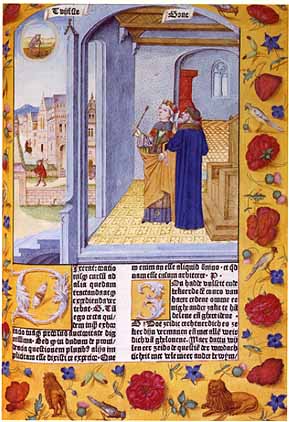
It is through Boethius that much of the thought of the Classical period was made available to the Western Medieval world. It has often been said Boethius was the “ and the first of the ”. From a 1385 Italian manuscript of the Consolation: Miniatures of Boethius teaching and in prisonThe philosophical message of the book fits well with the religious piety of the Middle Ages. Readers were encouraged not to seek worldly goods such as money and power, but to seek internalized virtues. Evil had a purpose, to provide a lesson to help change for good; while suffering from evil was seen as virtuous. Because God ruled the universe through Love, prayer to God and the application of Love would lead to true happiness. The Middle Ages, with their vivid sense of an overruling fate, found in Boethius an interpretation of life closely akin to the spirit of Christianity.
The Consolation of Philosophy stands, by its note of fatalism and its affinities with the Christian doctrine of humility, midway between the pagan philosophy of and the later Christian philosophy of consolation represented by.The book is heavily influenced by and his (as was Boethius himself). Its popularity can in part be explained by its and Christian ethical messages, although current scholarly research is still far from clear exactly why and how the work became so vastly popular in the Middle Ages. With in a medieval manuscript of a work by; The Consolation of Philosophy was responsible for the popularity of the goddess of Fortune and the wheel of fortune in the Middle AgesTranslations into the were done by famous notables, including , , , , and. Found within the Consolation are themes that have echoed throughout the Western canon: the female figure of wisdom that informs Dante, the ascent through the layered universe that is shared with Milton, the reconciliation of opposing forces that find their way into Chaucer in The Knight's Tale, and the Wheel of Fortune so popular throughout the Middle Ages.Citations from it occur frequently in 's. Of Boethius, Dante remarked “The blessed soul who exposes the deceptive world to anyone who gives ear to him.”Boethian influence can be found nearly everywhere in 's poetry, e.g. In, and, in the character of Lady Nature in and some of the shorter poems, such as Truth, The Former Age and Lak of Stedfastnesse.
Chaucer translated the work in his.The composer used some of the text in his choral work (1938). The composer quoted parts of it in his opera or music theatre work (1972–73), which was commissioned for the opening of the but was not ready in time.in says how “Boethian” much of the treatment of evil is in 's. Shippey says that Tolkien knew well the translation of Boethius that was made by King Alfred and he quotes some “Boethian” remarks from, and.Boethius and Consolatio Philosophiae are cited frequently by the main character Ignatius J. Reilly in the -winning (1980).It is a text, meaning that it is written in alternating sections of and metered.
In the course of the text, Boethius displays a virtuosic command of the forms of. It is classified as a, a fusion of tale, and lyrical poetry.In the 20th century there were close to four hundred manuscripts still surviving, a testament to its popularity. Reconstruction of the Lost Songs from The Consolation of Philosophy Hundreds of Latin songs were recorded in from the ninth century through to the thirteenth century, including settings of the poetic passages from Boethius's The Consolation of Philosophy. The music of this song repertory had long been considered irretrievably lost because the notational signs indicated only melodic outlines, relying on now-lapsed oral traditions to fill in the missing details.
Consolatio

However, by at the, extended in collaboration with medieval music ensemble, has shown that principles of musical setting for this period can be identified, providing crucial information to enable modern realisations. Sequentia performed the of the reconstructed songs from Boethius's The Consolation of Philosophy at, in April 2016, bringing to life music not heard in over 1,000 years; a number of the songs were subsequently recorded on the CD (Glossa, 2018).

Consolation Of Philosophy
Launched by the University of Cambridge in 2018 provides further details of the reconstruction process, bringing together,. See also.References.